Lenni Lenape Make Turtle Great Again
The long history of the Lenni Lenape, or Delaware people as nosotros are now known, reaches far back earlier the arrival of the Europeans. Since much has been lost over time, it is perhaps best to begin in the forested waterways of the Hudson River Valley. Ranging from ". . . the states of New Jersey and Delaware, that function of southeastern Pennsylvania lying between the Susquehanna and Delaware rivers, and the southeastern role of New York state west of the Hudson" (Weslager 1972: 33), the Delaware people today tin exist found in small enclaves across the U.S. and Canada. The largest populations reside mainly in Oklahoma and Ontario, Canada, with families and individual tribal members scattered across Due north America. Perhaps equally borderland artist George Catlin noted in Beginning Artists of the West, George Catlin Paintings and Watercolors (Troccoli 1993: 52), in describing the Delaware character and reaction to the continuous push button into unknown lands; "No other tribe on the continent has been so much moved and jostled well-nigh by civilized invasions; and none take retreated so far, or fought their mode so desperately, equally they have honourably and bravely contended for every human foot of the footing they take passed over." The Absentee Delaware, "absentee" being a description we were given early on, broke away from the master trunk of the tribe soon subsequently the American Revolution. European promises of the inclusion of a 14th state, an Indian state, were made as enticement to sign the outset treaty in 1778 between the fledgling United States and the Indians. Of grade no Indian land was ever declared and by 1782 continued expansion of the borderland and the violence oftentimes erupting from that expansion, compelled the Absentee Delaware to move beyond the borders of the newly formed United States into Spanish territory due west of the Mississippi River (Unhurt 1987:ane).
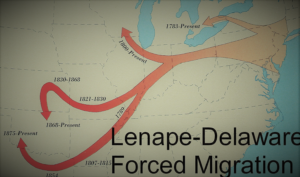 In 1793, the Delaware were given a country grant from the Bron de Carondelet, Governor General of Louisiana, which they would share with the Shawnees. This tract of land was located northwest of present-mean solar day Cape Girardeau, Missouri, along a drainage known every bit Apple Creek. After 1815, the Cape Girardeau Delaware (Absentee Delaware) continued south and southwest into Arkansas and the Indian territories while the main body of the tribe continued to reside in Ohio prior to entering into treaties which would bring about their relocation to southwest Missouri along the White River. Subsequently the Cape Girardeau group began moving due south, they would splinter into three groups; one group residing forth the northeast Texas edge, others almost present mean solar day Nacagdoches, Texas, and the third group near present-day Byars, Oklahoma in McCurtain County. These Delaware, forth with other bands seeking a place to live, would discover themselves removed from Texas three times earlier eventually settling on Wichita allotments in the Anadarko, Oklahoma are (Hale 1987: 2-5). Known until the belatedly 20th century as the Absentee Delaware, so the Delaware Tribe of Western Oklahoma, we are at present the federally recognized, Delaware Nation.
The Delaware creation story tells u.s. i solar day the rain came and the People prayed to our Creator as the waters rose. The Creator directed the People to a large hill and told them to camp upon information technology. Equally the rain continued to fall the water began to pool and rise around them, so they moved to the very top of this hill. Equally the water crept up toward them wetting their feet, the loma began to tremble and shake. Rising up with the People upon its back was the not bad Taakox, or turtle, who had been hiding beneath the hill for many years. Taakox saved the Delaware people and they survived upon his back until the waters receded. In the volume, Turtle Tales: Oral Traditions of the Delaware Tribe of Western Oklahoma, Martha Ellis tells the story of how nosotros came to this continent, ofttimes referred to by Northeastern and Canadian Indian people as Turtle Isle;
"My female parent used to say, we came from some other island (I guess I will say), not in this . . . She said, "Nosotros crossed, nosotros had to become way up in the North Pole, and the sea was all frozen." They had to become that fashion. So, these Delawares did accept enough to eat on, simply they ran out of nutrient right in the eye. And so they started eating any, they were so hungry. Finally, they got on this side and that is all I know. My mother was telling u.s.a.. That's all." The Walum Olum (crimson score) is our recounting of "where we come from." Recorded in what are known equally mnemonic glyphs (somewhat similar to Egyptian hieroglyphs), these stories were traditionally shared through storytelling and at some point an individual decided to record the stories onto wooden strips. The assumption past late 19th and early 20th century interpreters of the Walum Olum is that the oral tradition was passed downwards from one person to another although if this selection were based upon clan, family or other means remains unknown.
The part which intrigues is within what is chosen Book Three of the Walum Olum in verses xv through seventeen: "All of them said they would go together to the state at that place, all who were complimentary . . . the Northerners were of one mind and the Easterners were of one mind; information technology would be expert to live on the other side of the frozen water. Things turned out well for those who stayed at the shore of h2o frozen hard as rocks, and for those at the great hollow well" The mnemonic glyphs were interpreted in the late 19th century by Dr. Daniel G. Brinton, and from his estimation the Walum Olum suggests two groups of people decided to exit their homelands in what is now modernistic twenty-four hour period Siberia moving across the once frozen Bering Strait southward beyond the Yukon until arriving at the head waters of the Mackenzie and Columbia Rivers. There one grouping would motility southeasterly over the subsequent generations eventually arriving at Namaesi Sipu, or the Mississippi River. Every bit the first inhabitants of what is now the northeastern U.s.a., the Waopanachke or Lenni Lenape, were known as the grandfathers addressing other tribes within the Algonkian family as their grandchildren. The kinship ties among the tribes comprising the Algonkian group considered the Delaware to exist the oldest existing tribe among them which suggests nosotros were the first to occupy the region. According the Walum Olum not all the Delaware people moved into the four rivers surface area only 1 group remained along the eastern bank of the Mississippi while another group remained west of the river. From the Delaware who settled in the northeastern function of our continent would come up our three clans; the Munsee (Wolf Clan), the Unami (Turtle Clan) and the Unalachtigo (Turkey Clan).
Nekole Alligood, Manager of NAGPRA
Source: https://www.delawarenation-nsn.gov/history/

Post a Comment for "Lenni Lenape Make Turtle Great Again"